

Source: PubMed record for Medicine & Science in Sports & Exercise study; DOI: 10.1249/MSS.0000000000004067.
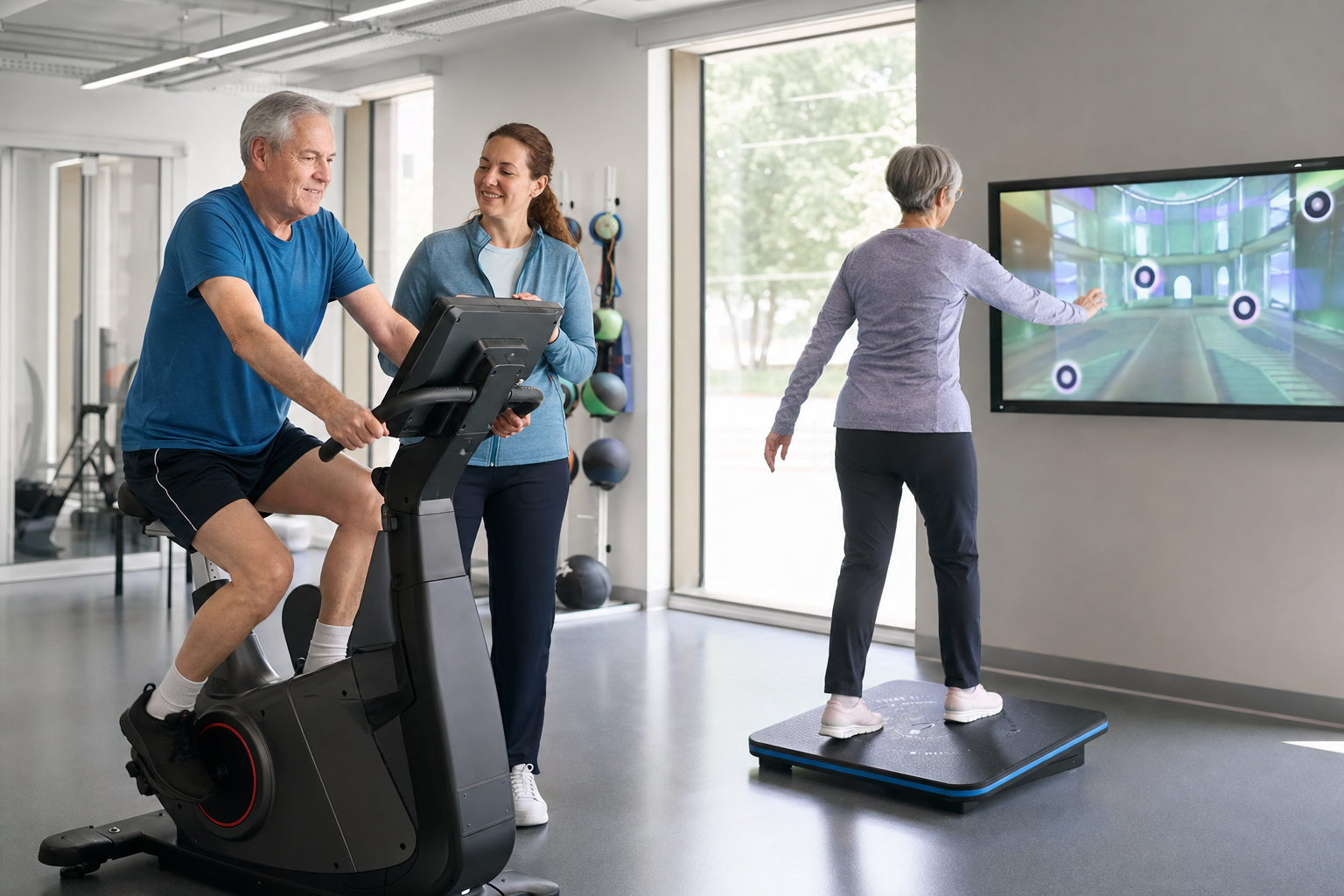
A new PubMed-indexed study in Medicine & Science in Sports & Exercise compared eight weeks of traditional aerobic exercise with exergaming in middle-aged and older adults. The trial included 33 participants, with both groups training under supervision three times per week for 30 minutes per session.
Both approaches improved estimated VO2max, chair-stand performance, timed-up-and-go performance, and accuracy on cognitive task conditions. The exergaming group showed an extra advantage only in the most demanding fast dual-task condition, along with signals of more efficient prefrontal activation.
Why it matters for lifters
For older lifters and coaches, the useful takeaway is not that a game screen replaces structured training. It is that moderate aerobic work and interactive movement challenges may both support fitness and task performance when they are supervised, repeatable, and progressed over time.
That matters because aging athletes often need more than maximal strength work. Gait speed, chair-rise ability, coordination under distraction, and aerobic capacity can influence how well someone moves between sets, recovers from training, and stays confident in daily activity.
What to watch next
The study was small, and the exergaming benefit appeared mainly under the hardest dual-task test. Larger trials should clarify which game formats, intensities, and progression models work best, and whether the results translate to falls, adherence, and long-term training outcomes.
Coaches working with older adults should watch for follow-up studies that compare exergaming against strength-plus-aerobic programs, not just aerobic exercise alone. The practical question is how to add cognitive-motor challenge without diluting the resistance training that older athletes still need.
This article is for informational purposes only and is not medical advice. People with cardiovascular, neurological, balance, or mobility concerns should speak with a qualified healthcare professional before changing their exercise routine.