

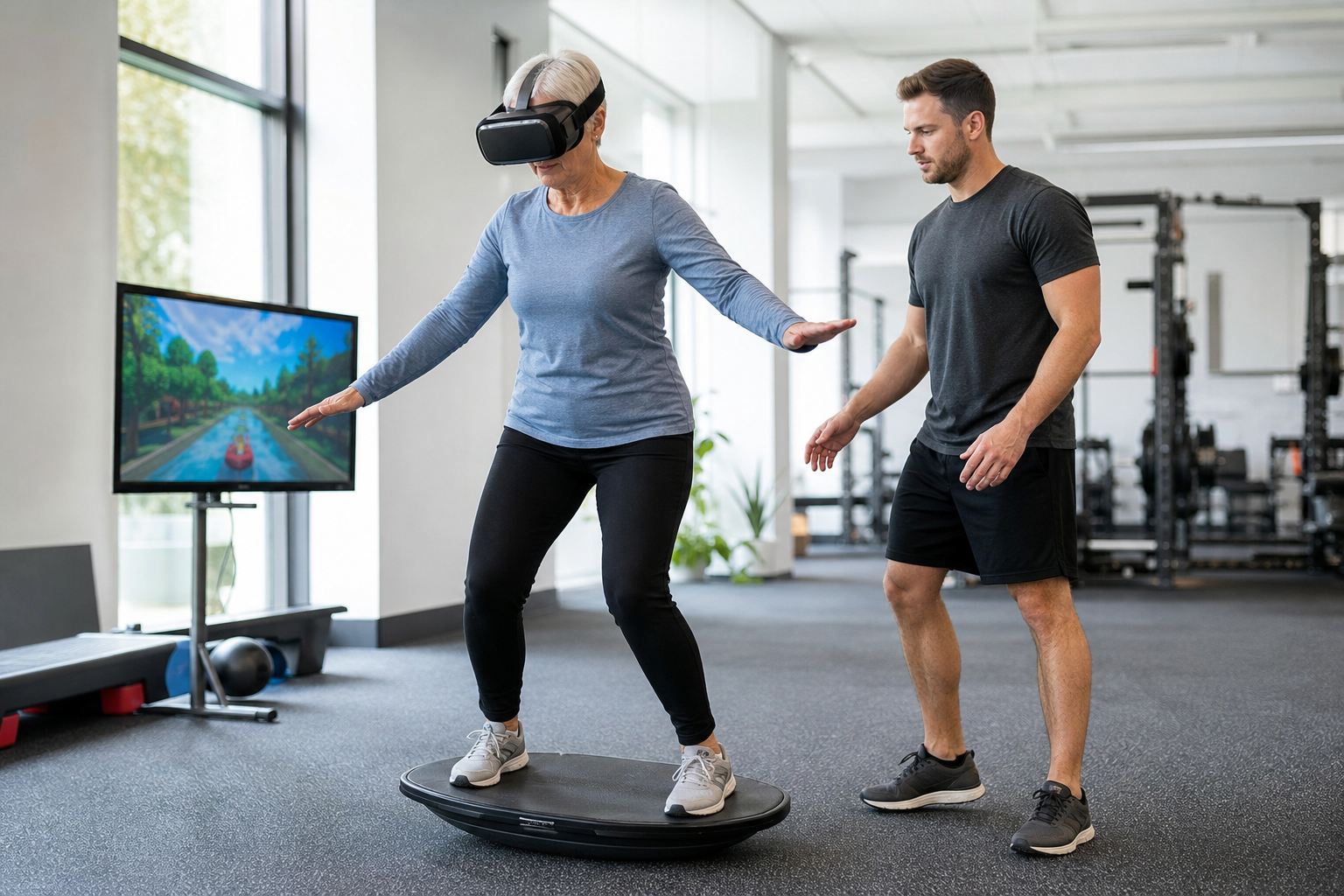
Source credit: BMC Geriatrics, indexed in PubMed: “Effects of game-based virtual reality balance training on postural stability and mobility in community-dwelling older adults: an exploratory randomized controlled trial”. DOI: 10.1186/s12877-026-07914-9.
Short summary
A July 3 PubMed-indexed exploratory randomized controlled trial in BMC Geriatrics tested whether supervised game-based virtual reality balance training could improve balance and mobility in community-dwelling adults age 65 and older. Forty participants were assigned either to an eight-week supervised VR balance program using the Biodex Balance System or to a control group that received home exercise videos, health education, and weekly reminder calls.
The VR group completed two supervised sessions per week for eight weeks. Compared with the control group, researchers reported statistically significant group-by-time differences for several postural sway measures, Timed Up and Go performance, and single-leg stance performance. No adverse events were reported. The authors also noted that fall-related concern increased in both groups, so that finding should be interpreted carefully.
Why it matters for lifters
For lifters, the practical angle is not that VR is required for better balance. It is that structured, supervised balance work can be progressed, measured, and made more engaging for older adults who need confidence and movement quality before heavier training becomes realistic.
Balance, single-leg control, and the ability to move while handling another task are all part of durable training capacity. A lifter returning after a fall, joint issue, long layoff, or age-related decline may benefit from a phase that treats balance work as real programming instead of a throwaway warmup.
What to watch next
This was a small exploratory trial, so larger studies need to confirm the results, compare VR training with well-supervised conventional balance programs, and track whether gains reduce real-world falls or improve gym-relevant outcomes. Future work should also clarify which people benefit most, how long improvements last, and whether lower-cost tools can deliver similar adherence and feedback without specialized equipment.
Health disclaimer: This article is for informational purposes only and is not medical advice. It should not be used to diagnose, treat, prevent, or manage falls, injuries, neurological conditions, or age-related mobility changes. Talk with a qualified clinician, physical therapist, or other licensed professional before starting a new balance, rehabilitation, or training program, especially if you have fallen recently, feel dizzy, use assistive devices, or have a medical condition.