

Source credit: Based on a June 26, 2026 Sports Health paper indexed by PubMed: “Therapeutic Exercises Induce Distinct Regional Activation Patterns of the Fibularis Longus Muscle in People With Chronic Ankle Instability”. DOI: 10.1177/19417381261457122.
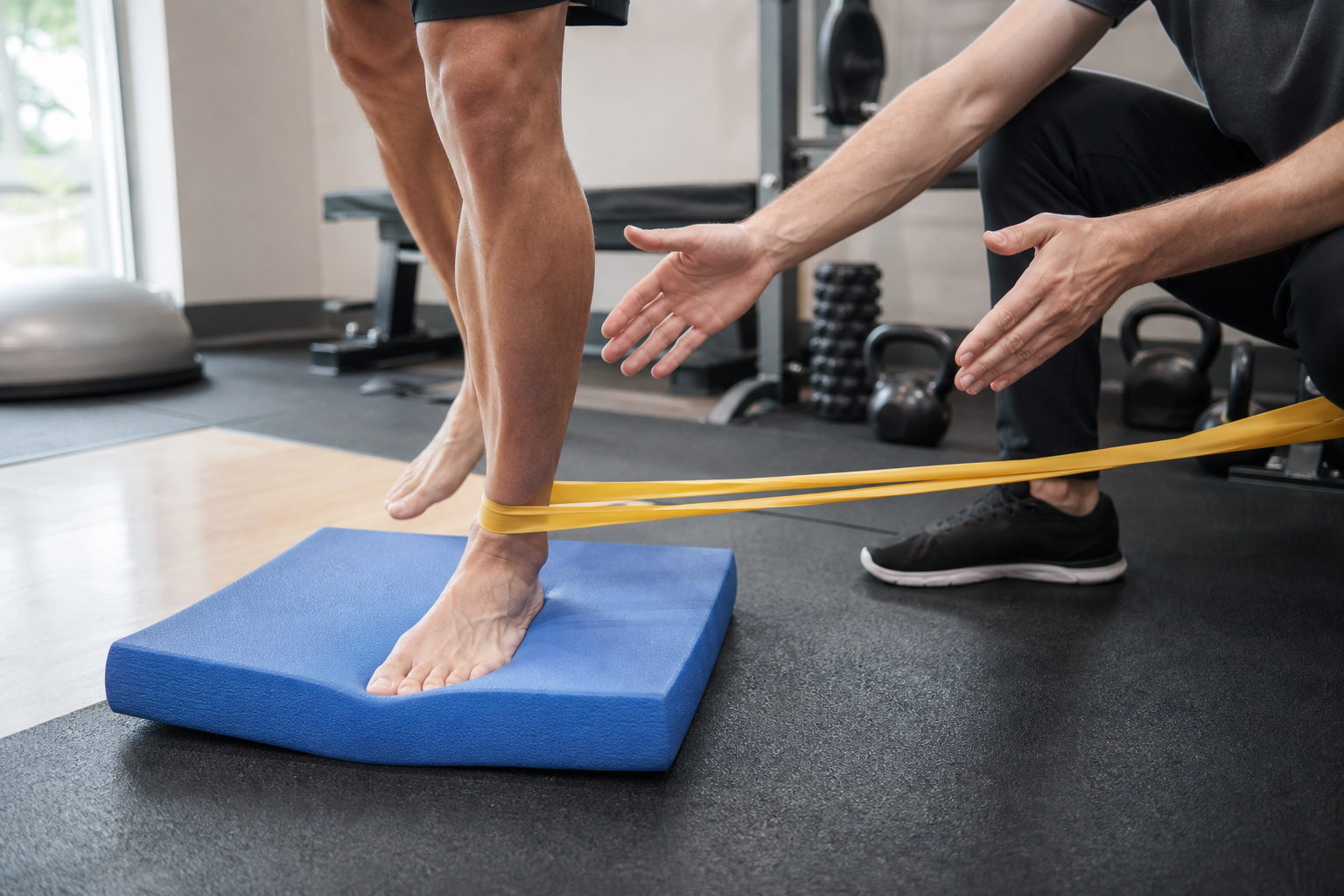
A new laboratory study suggests that common ankle rehab drills grouped under “fibular strengthening” may not train the fibularis longus muscle in the same way. Researchers compared 20 physically active adults with chronic ankle instability and 20 controls during band-resisted eversion and two BOSU-based tasks, using high-density surface EMG to map regional muscle activation.
The key takeaway was not that one drill is universally best. Instead, the study found that band-resisted eversion was associated with more posterior-region fibularis longus activation in the chronic ankle instability group, while BOSU-based tasks shifted activation more toward the anterior region. For athletes with repeat ankle sprains, that difference could matter when a clinician is choosing exercises for a specific rehab goal.
Why it matters for lifters
Squats, lunges, loaded carries, Olympic-lift receiving positions, and heavy calf work all ask the foot and ankle to stabilize under load. If a lifter has chronic ankle instability, generic balance drills may not address the exact neuromuscular deficit they are trying to fix. This paper supports a more precise approach: match the exercise to the target tissue and training phase instead of assuming every wobble-board or band drill does the same job.
The study is also a reminder to keep rehab claims modest. It measured acute activation patterns in a small lab sample, not long-term return-to-sport outcomes, reinjury rates, or strength gains. Lifters dealing with repeated sprains should use the findings as a conversation starter with a physical therapist, athletic trainer, or sports-medicine clinician rather than as a self-prescribed protocol.
What to watch next
Watch for follow-up studies that test whether exercise selection based on regional fibularis longus activation improves symptoms, balance, force production, or reinjury risk over weeks of training. The most useful next step would be a clinical trial comparing targeted band work, unstable-surface tasks, and combined progressions in athletes returning to jumping, cutting, squatting, and loaded lower-body training.
This article is for informational purposes only and is not medical advice. If you have ankle pain, recurrent sprains, instability, numbness, swelling, or trouble bearing weight, consult a qualified health professional before changing your training or rehab plan.