

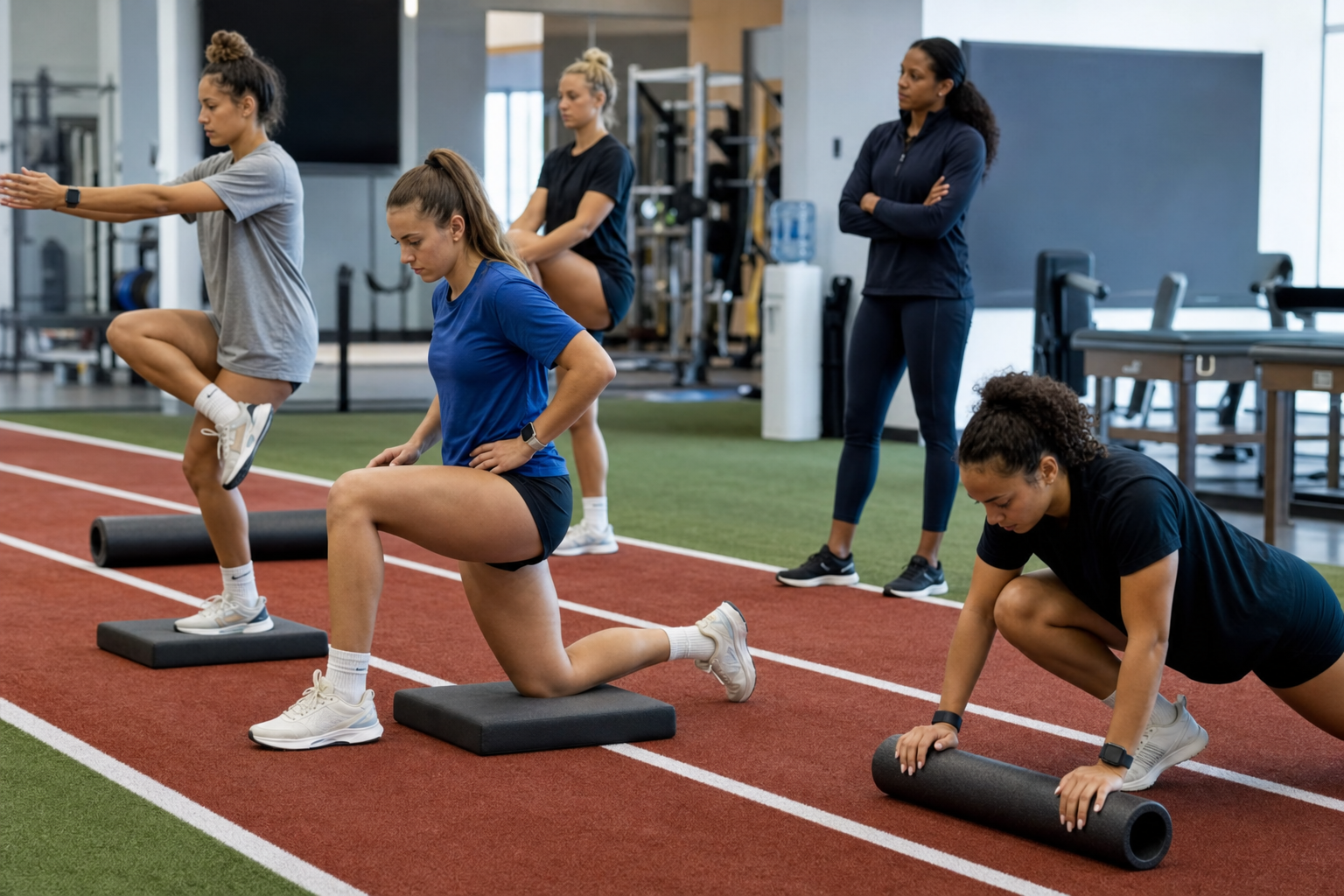
Source credit: Based on the June 28, 2026 PubMed-indexed Research in Sports Medicine article, “Injury incidence in NCAA women’s sports during 2019/20-2021/22: findings from injury surveillance during the COVID-19 pandemic”. DOI: 10.1080/15438627.2026.2693552.
A new sports-medicine surveillance paper puts hard numbers behind a problem coaches already see in busy training rooms: injuries in women’s college sports are not evenly distributed across body regions or sport demands.
The study analyzed NCAA women’s sport injury data from the 2019/20 through 2021/22 seasons, covering a period disrupted by the COVID-19 pandemic. Researchers reported 10,417 injuries and estimated an overall injury rate of 5.2 per 1,000 athlete-exposures, with a 95% credible interval from 4.7 to 5.3.
Lower-leg and foot injuries stood out, accounting for 29.6% of reported injuries. The paper also estimated the highest overall injury incidence in gymnastics, at a posterior mean rate of 7.9 per 1,000 athlete-exposures, although the credible interval was wide. The authors framed the patterns as sport-specific rather than one universal injury story.
This is surveillance research, not a trial of a prevention program. It cannot prove which warm-up, strength plan, shoe choice, workload rule, or medical-screening approach prevents injuries. It does, however, give coaches and athletes a useful map of where injury attention may be most needed.
Why it matters for lifters
Even lifters who do not play NCAA sports can learn from this pattern. Lower-leg and foot capacity matters for squats, Olympic-lift catches, lunges, loaded carries, sled pushes, jumps, conditioning work, and return-to-sport training after time away.
The practical takeaway is not to add random “prehab” drills forever. It is to make lower-leg work specific: calf and soleus strength, ankle control, foot tolerance, landing mechanics, progressive running or jumping exposure, and recovery monitoring should match the sport, the athlete, and the current training load.
For coaches, the paper also reinforces why one-size-fits-all injury planning is weak. A gymnast, basketball player, soccer player, and lifter returning from an ankle sprain may all need different progressions even if the vulnerable region looks similar on a spreadsheet.
What to watch next
The next useful step would be prevention and return-to-training studies that connect surveillance patterns with specific interventions: workload changes, landing programs, lower-leg strength blocks, recovery screens, and sport-specific progressions.
It will also be worth watching whether post-pandemic training disruptions changed injury risk in ways that persist after normal schedules returned. Surveillance can point to the problem, but coaches still need practical trials to know which fixes hold up in real programs.
Health disclaimer: This article is for informational purposes only and is not medical advice. If you have pain, swelling, repeated sprains, stress-injury symptoms, or trouble returning to training, consult a qualified medical or sports-medicine professional before changing your program.