

Source credit: Based on the PubMed-indexed Journal of Strength and Conditioning Research article, PubMed 42342242, DOI 10.1519/JSC.0000000000005532.
A new Journal of Strength and Conditioning Research study gives lifters a close look at what happens when elite powerlifters squat near max and at max load.
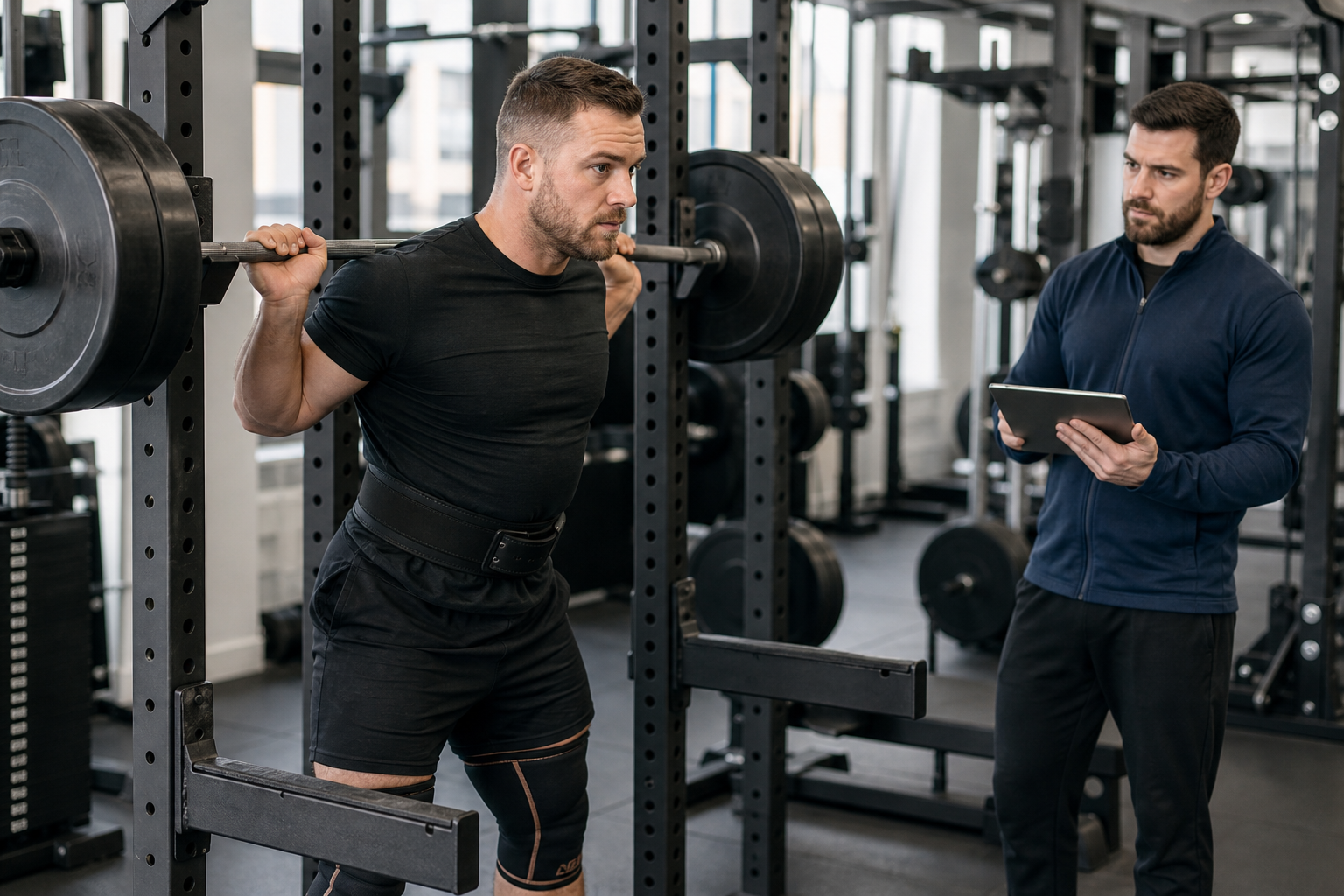
The researchers analyzed eight elite national powerlifters as they performed single back-squat reps at 90%, 95%, and 100% of one-rep max. The team broke the ascent into pre-sticking, sticking, and post-sticking regions, then examined bar speed, joint angles, hip torque, knee torque, and the balance between hip and knee contribution.
The headline finding was not just that heavy squats get slower. Across the lift, hip torque was higher than knee torque, and during the sticking region the hip-to-knee torque ratio exceeded 3:1. The authors noted that this suggests elite powerlifting-style squats may depend on the hip extensors more than what has been reported in recreational lifters.
As load increased, the athletes also showed higher knee torque early out of the bottom, more forward lean near the end of the sticking region, and reduced lifting velocity through the sticking and post-sticking phases. Even so, the top-level lifters largely maintained their hip-versus-knee load distribution as the bar got heavier.
Why it matters for lifters
For powerlifters, the study supports a practical point coaches often see under the bar: a max-effort squat is not just a quad test. Strong hip extension, trunk position, and the ability to keep driving through the sticking region can be decisive when the load is near a true max.
That does not mean every lifter should force a more bent-over squat. The paper studied elite powerlifters, not beginners or general gym trainees, and technique still depends on anatomy, stance, bar position, goals, and injury history. The useful takeaway is to train the whole squat pattern, including hip extension strength and control under heavy-but-clean singles.
For bodybuilders, the finding is also a reminder that squat style changes the stimulus. A powerlifting-oriented squat may load the hips heavily, while lifters chasing more quad bias may need to adjust stance, depth tolerance, tempo, machine selection, or accessory work rather than assuming all squats stress the legs the same way.
What to watch next
Watch for follow-up work comparing elite powerlifters with intermediate lifters, bodybuilders, and different squat styles. The most useful next step would be practical evidence on which accessory lifts, cues, or periodized blocks improve sticking-region performance without increasing injury risk.
Also watch whether velocity tracking and joint-torque analysis become more actionable for everyday coaching. The current study is valuable because it describes what elite lifters do under maximal loads, but translating that into programming still requires judgment, fatigue management, and individual technique review.
Health disclaimer: This article is for informational purposes only and is not medical advice. Heavy squatting can carry injury risk, especially near maximal loads. If you have pain, a medical condition, or are returning from injury, work with a qualified health professional or coach before changing your training plan.