

Source credit: PubMed / Journal of Applied Physiology, “Can we assess exercise metabolism from skin? Metabolomic profiles in skin dialysate collected during exercise”. DOI: 10.1152/japplphysiol.01017.2025.
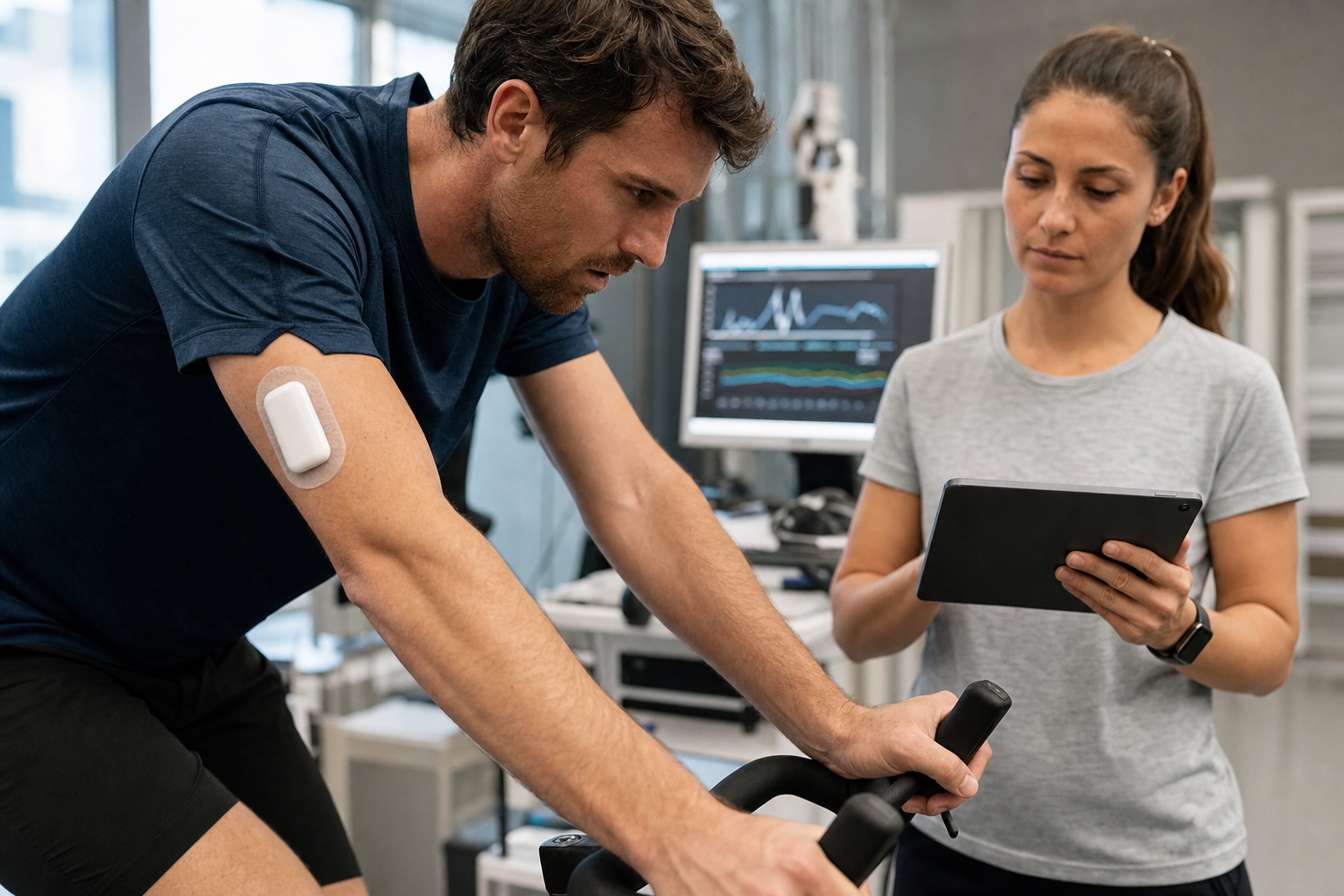
Short summary: A newly indexed Journal of Applied Physiology study tested whether metabolites collected from skin interstitial fluid during exercise line up with standard exercise-metabolism measurements. In 12 young adults completing low-, moderate-, and high-intensity exercise stages, several skin-dialysate metabolites tracked with changes in whole-body fuel use measured by indirect calorimetry.
Indirect calorimetry remains the lab standard for measuring metabolic stress during exercise, but it requires equipment that is not practical for everyday training. The researchers used intradermal microdialysis to collect skin dialysate while participants exercised at 25%, 50%, and 75% of VO2peak for 20 minutes per stage.
The signal was preliminary but interesting: medium- and long-chain acylcarnitines rose during moderate-intensity work in parallel with higher fat oxidation, while lactic acid increased during the high-intensity phase alongside greater carbohydrate oxidation. The authors framed the findings as early evidence that skin interstitial fluid could help inform future continuous exercise-intensity monitoring.
Why it matters for lifters
Lifters already use heart rate, RPE, bar speed, step counts, sleep scores, and wearable recovery metrics to guide training. This study points toward a possible next layer: biochemical feedback that may someday help distinguish moderate aerobic work, harder conditioning, and high-glycolytic efforts without a full lab setup.
For now, it should not change a training plan. The study was small, used a controlled graded protocol, and did not test a consumer wearable. The practical takeaway is more cautious: future devices may become better at describing what kind of metabolic stress a workout creates, but athletes still need sound programming, progressive loading, recovery, and context.
What to watch next
Watch for larger studies that test different ages, trained lifters, endurance athletes, people with metabolic conditions, and real-world sessions such as intervals, circuits, heavy lower-body training, and mixed conditioning. The key question is whether skin-fluid signals can be captured noninvasively and interpreted accurately enough to help athletes make decisions.
If this research direction holds up, coaches may eventually get better tools for separating easy aerobic work from threshold sessions and high-fatigue conditioning. Until then, lifters should treat wearable data as one input rather than a substitute for performance, recovery, and symptoms.
Health disclaimer: This article is for informational purposes only and is not medical advice. Talk with a qualified healthcare professional before changing your training, conditioning, diagnosis, treatment, supplements, or injury-management plan.