

Source credit: Based on the June 29, 2026 PubMed-indexed Journal of Strength and Conditioning Research article, “Isometric Floor Press: A Valid, Reliable, and Practical Field-Based Assessment of Upper-Body Strength”. DOI: 10.1519/JSC.0000000000005585.
A new strength-and-conditioning study suggests that the isometric floor press may give coaches a practical way to measure upper-body strength without asking every athlete to max out a bench press.
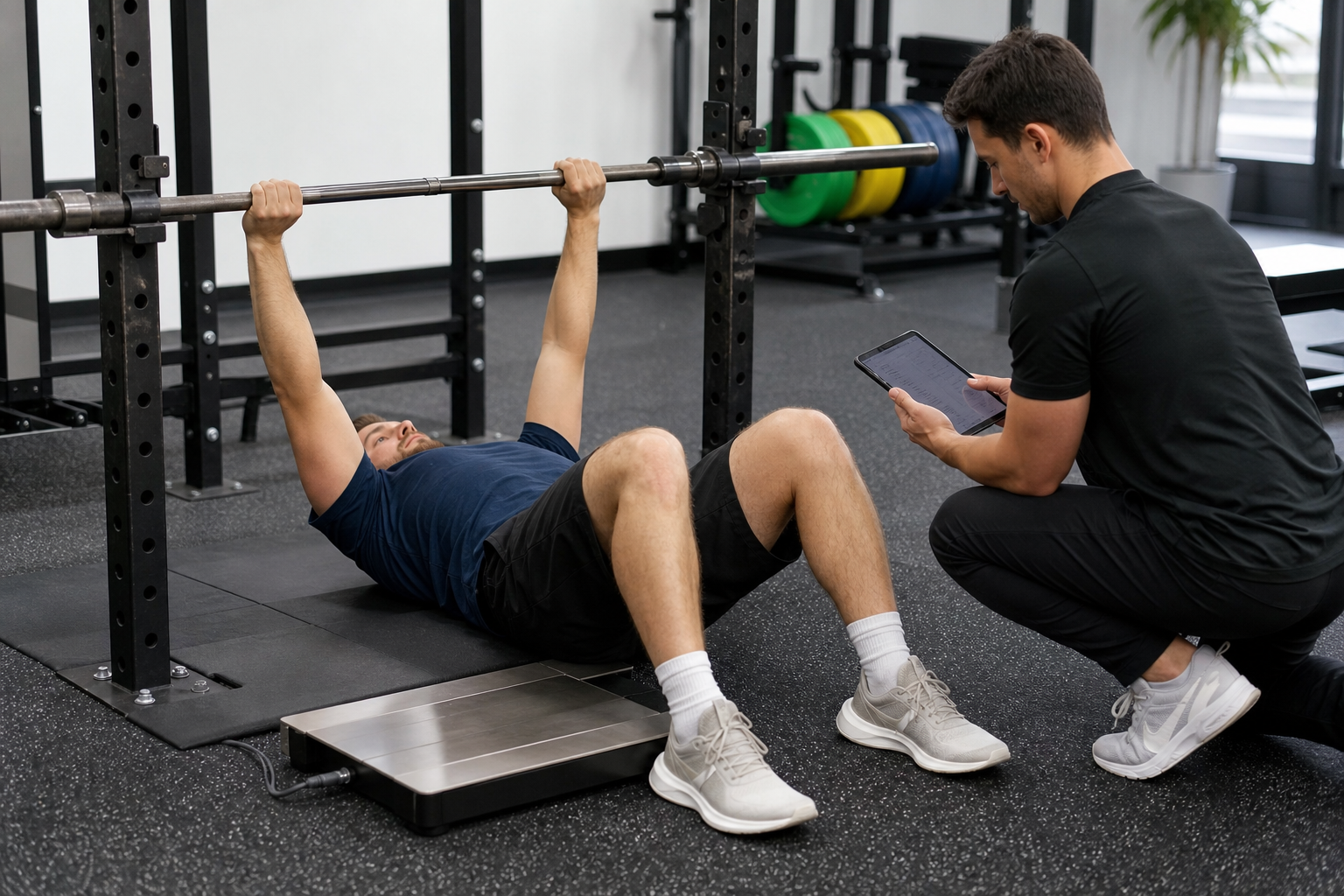
The study tested 20 recreationally trained adults across four field-friendly upper-body isometric assessments: push-up variations from the knees and feet, plus floor-press positions at 90-degree and 135-degree elbow angles. Participants also completed a one-repetition maximum bench press, giving researchers a standard comparison point.
The 90-degree isometric floor press showed the strongest relationship with bench-press 1RM, with a reported correlation of 0.887. The 135-degree version and both push-up tests also correlated with bench strength, but the supine floor-press setup generally produced steadier measurements than the prone push-up variations.
Reliability was also strong. Across the tests, within-day intraclass correlation coefficients ranged from 0.923 to 0.983, while between-day values ranged from 0.912 to 0.955. The authors framed the method as useful for applied settings where safety, measurement sensitivity, and lower fatigue are priorities.
The limits matter. This was a small study, and the participants were recreationally trained rather than elite powerlifters, collision-sport athletes, or injured return-to-play cases. It also used force-plate and rack equipment, so it is not the same as a no-equipment home test.
Why it matters for lifters
For lifters, upper-body testing often defaults to heavy singles. That can be useful, but it is not always the right tool during fatigue, injury return, deload weeks, team testing days, or blocks where the goal is monitoring rather than peaking.
An isometric floor press gives coaches a possible middle ground: enough force output to track pressing strength, but less technical and recovery cost than repeated maximal bench attempts. It may be especially useful when the athlete needs a consistent benchmark without changing the whole training week around a test day.
The practical takeaway is not to replace all bench testing. It is to choose the test that matches the question. A powerlifter still needs competition-specific bench data, while a field coach, rehab professional, or general strength coach may benefit from a lower-risk upper-body force test that can be repeated more often.
What to watch next
Future work should test larger groups, women-specific samples, higher-level athletes, injured lifters, and return-to-play settings. It would also be useful to know whether changes in isometric floor-press force predict future bench-press gains, shoulder tolerance, or sport performance rather than simply matching a one-time 1RM test.
Lifters should also watch for practical standards: setup height, elbow angle, warm-up protocol, number of attempts, rest periods, and what counts as a meaningful change instead of normal day-to-day measurement noise.
Health disclaimer: This article is for informational purposes only and is not medical advice. Anyone with shoulder, elbow, wrist, chest, neck, or back pain should consult a qualified medical or sports-medicine professional before adding maximal or near-maximal strength testing.