

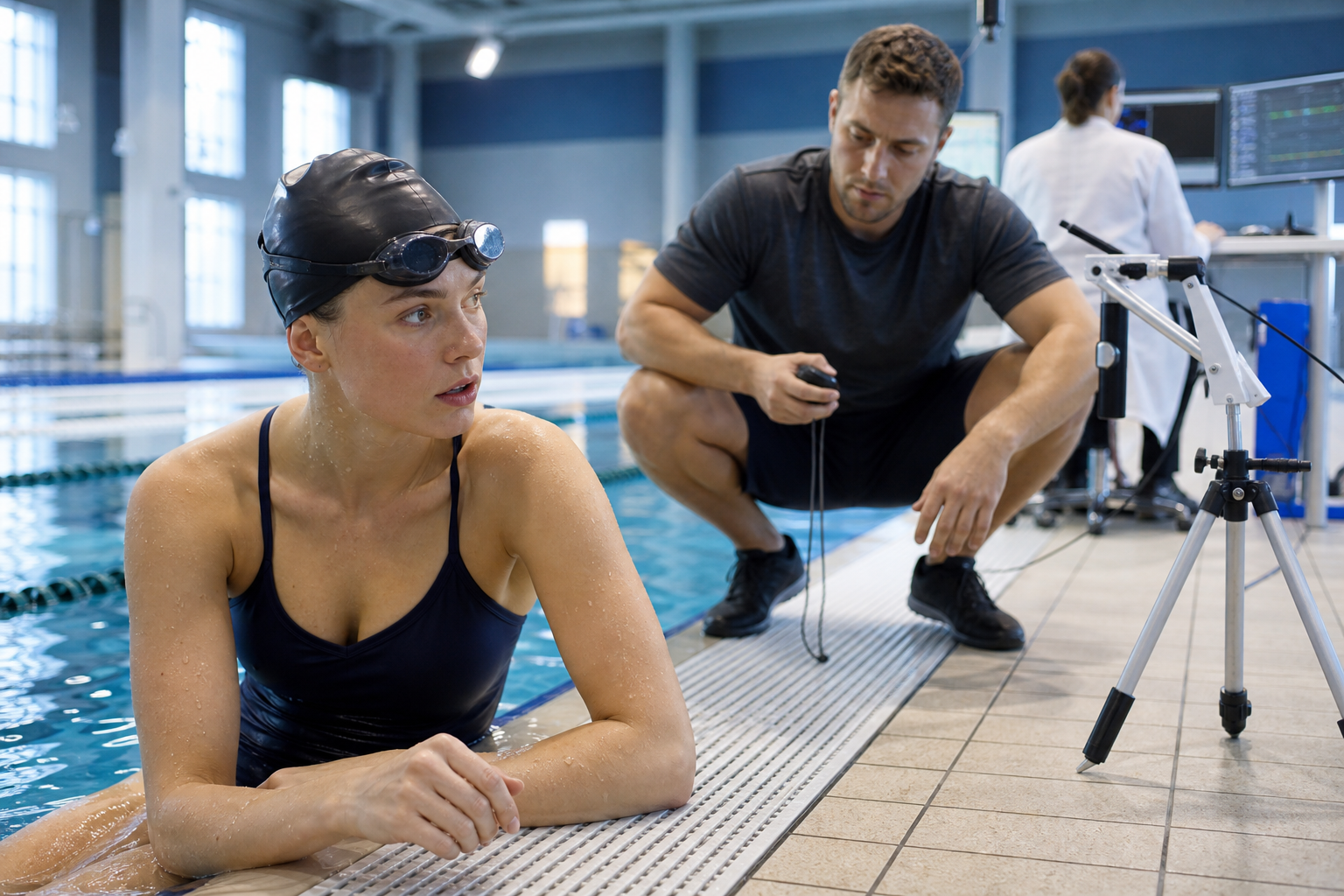
Source credit: European Journal of Applied Physiology, indexed in PubMed: “Moderate altitude-mimicking CO-induced inhibition of hemoglobin oxygen binding decreased middle-distance swimming speed in male national-level swimmers”. DOI: 10.1007/s00421-026-06339-x.
Short summary
A July 3 PubMed-indexed study in the European Journal of Applied Physiology tested whether a short-term reduction in blood oxygen transport capacity would affect 200 m front-crawl performance in national-level swimmers. In a double-blind randomized crossover design, 12 swimmers completed two time trials after either a moderate laboratory carbon monoxide rebreathing condition or a smaller sham condition.
At the group level, male swimmers were about 1.5 percent slower in the moderate oxygen-transport reduction condition, while the study did not find a significant difference in the women. Eight of the 12 swimmers were slower under the reduced oxygen-binding condition, with individual differences ranging from 1.1 to 5.0 seconds. Blood lactate changes during the time trials were not meaningfully different between conditions.
Why it matters for lifters
This is a swim-performance study, but the broader training lesson is familiar to lifters: small physiological limits can matter when the athlete is already highly trained and the event is decided by narrow margins. Oxygen delivery, pacing, breathing rhythm, and technical efficiency can interact in ways that a simple “more effort” explanation misses.
For strength athletes and hybrid athletes, the practical takeaway is not to copy the lab method. It is to respect conditioning, recovery, breathing control, and event-specific fatigue as part of performance planning, especially when training includes repeated hard sets, loaded carries, circuits, or sport practice on top of lifting.
What to watch next
The study was small, and the sex-specific result needs confirmation in larger cohorts. Future work should test more swimmers, different race distances, and real-world altitude or hypoxic-training settings while separating oxygen transport from technique, pacing, and breathing constraints in the pool. The most useful follow-up for coaches would be evidence that helps identify which athletes are limited most by aerobic transport versus skill or race execution.
Health disclaimer: This article is for informational purposes only and is not medical advice. The carbon monoxide rebreathing condition described in the study was a controlled research method and should not be attempted outside qualified laboratory supervision. Talk with a qualified clinician, coach, or sports medicine professional before using hypoxic, altitude, breath-control, or high-intensity conditioning methods, especially if you have cardiovascular, respiratory, neurological, or blood-related health concerns.