

Source credit: Based on a PubMed-indexed Sports Medicine – Open study, “Machine Learning-Based Prediction of Track Sprint Cycling Performance in Elite-Level Male Cyclists”, DOI: 10.1186/s40798-026-01058-1.
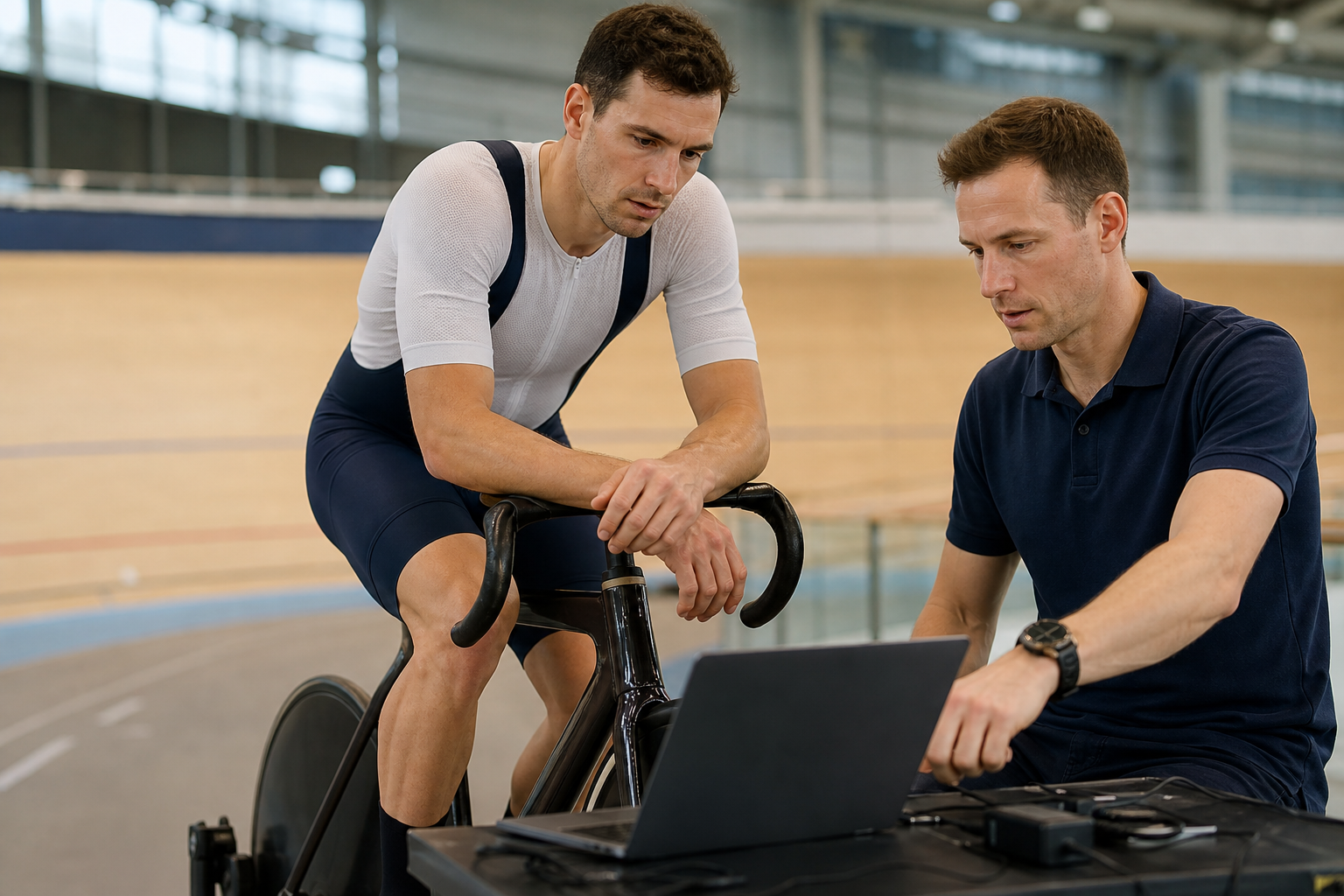
A new multinational cross-sectional analysis in Sports Medicine – Open tested whether lab sprint-bike data could predict indoor velodrome flying sprint performance in elite male track cyclists. The study included 333 cyclists who completed a 30-second all-out cycle-ergometer sprint test plus flying 100-meter and 200-meter efforts.
The researchers compared multiple linear regression with tuned random forest models using eight ergometer-derived predictors, including body mass, peak power, 30-second mean power, cadence, relative peak power, five-second power normalized to body mass, and power-drop measures. The best-performing models were still modest: random forests explained about 37% of 100-meter performance variance and 39% of 200-meter variance on the test set.
The practical signal was narrower than the artificial-intelligence headline might suggest. Thirty-second average power was the only independent predictor in the adjusted linear models, while random forest importance analyses ranked relative peak power and 30-second average power as the most influential inputs. Percentage power drop did not independently explain the second half of the sprint once peak power was considered.
Why it matters for lifters
For strength and physique athletes, the study is a reminder that testing should start with the variables closest to the target performance. Novel models can be useful, but a fancy dashboard may add only a small edge if the core test does not capture the sport demand. In this dataset, sustained high power and power relative to body size carried more signal than a simple fatigue drop-off score.
What to watch next
Future work should test whether these models hold up in women, junior athletes, different cycling programs, and repeated within-athlete monitoring across training blocks. Coaches should also watch for studies that combine lab power, track tactics, start mechanics, resistance training data, and recovery markers instead of relying on one sprint-bike test.
Health disclaimer: This article is for informational purposes only and is not medical advice. Athletes should make testing, training, injury, and nutrition decisions with qualified medical, coaching, or sports-performance professionals.